

The cars that ate Brisbane


Brisbane, a place where everyone drives because walking is unpleasant, and walking is unpleasant because everyone drives. A perfect, self-sustaining nightmare. It’s no wonder Brisbane was recently voted as having Australia's worst traffic.
This city has been designed with all the subtlety of a pub brawl at the Royal Exchange Hotel and the foresight of a bloke who thinks peak hour is a myth invented by cyclists. Brisbane didn’t just allow cars to take over: it lay down and let them chew the place to bits, appeasing an internal combustion god that demands constant sacrifice. Time. Space. Occasionally, pedestrians.
Walk anywhere beyond the CBD, and you’ll see it too. Slip lanes engineered to keep drivers from ever lifting their foot off the accelerator, traffic lights timed to punish anyone not wrapped in steel. Pedestrians are treated like suspicious loiterers, tolerated only if they hurry up and get out of the road.
The great irony is that Brisbane pretends to be laid-back. “No worries,” the city says, while forcing you to sprint across six lanes of leering traffic while balancing your morning matcha. There is nothing relaxed about standing on a baking median strip, breathing carbon monoxide fumes, watching a green man flash for four seconds before condemning you to wait another full cycle of your life.
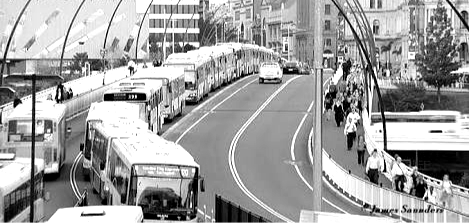
This is not accidental. This is policy. Decades of council traffic engineers worshipping at the altar of flow, speed and vehicle throughput. Bipeds be damned. It stems back from Clem Jones ripping up the city’s tram network and replacing it with an ersatz bus network that didn’t really go as far as the trams and spewed out fumes trying to get up the hilly city’s outskirts. The result is a city optimised for commuting misery.
Cyclists, of course, exist in a legal twilight zone. They are either scolded, endangered and blamed for traffic they did not create. But pedestrians cop it worst. They are the unprotected, the unfunded, the politically invisible. No registration fees. No lobby groups. And yet, beneath the asphalt madness, Brisbane wants to be human.

In West End, it almost works. Where a green strip of cycling path just suddenly and nonsensically ends at the top of Dornoch Terrace, as if they ran out of funding for the half-baked project. You see it on riverside paths where people briefly remember they have legs, in the quiet rebellion of anyone who chooses to walk despite the odds. These are glimpses of a city that could be navigable, sociable, and sane.
But for now, the cars have eaten Brisbane like that sinister Peter Weir film from the 70s that still gives me the creeps. They’ve gnawed away at its streets, its public life, its sense of proportion. They’ve turned the simple act of walking into an extreme sport. Until the city decides that people matter more than traffic models, we’ll keep feeding the machine - one frustrated commute, one missed crossing, one near-miss at a time.
And the engines keep roaring, hungry for more.

Poster for the Australian horror-comedy film 'The Cars That Ate Paris' (Peter Weir, 1974)


